
Eagle · Garfield · Pitkin · Summit County, Colorado
Deck Builder & Custom Decks
Built for the snow that sits on it and the freezing that comes after.
I’m a deck builder, not a sales office. Most of the decks I get called to tear out didn’t fail because of the wood. They failed because of how they were put together — the flashing, the drainage, the footings. I build them so the next guy doesn’t get that call in fifteen years.
- 11 years in these mountains
- $0 for the estimate
- 1 carpenter, start to finish
Building for this climate
A deck here isn’t the same deck as one in Denver
In Vail, measurable snow falls in ten of the twelve months — about 189 inches a year, spread across roughly 67 separate snow days. Only July and August come through clean. Each of those days is another round of melt during the daytime and freeze overnight, and that cycle is what takes a deck apart.
Average monthly snowfall, Vail — inches
Source: NOAA climate normals, 1991–2020.
So the decisions that matter aren’t the ones you see when it’s finished. They’re underneath:
The ledger and the flashing. Where the deck attaches to the house is the most common failure point and the most dangerous one. It gets flashed so water runs out instead of sitting in the joint.
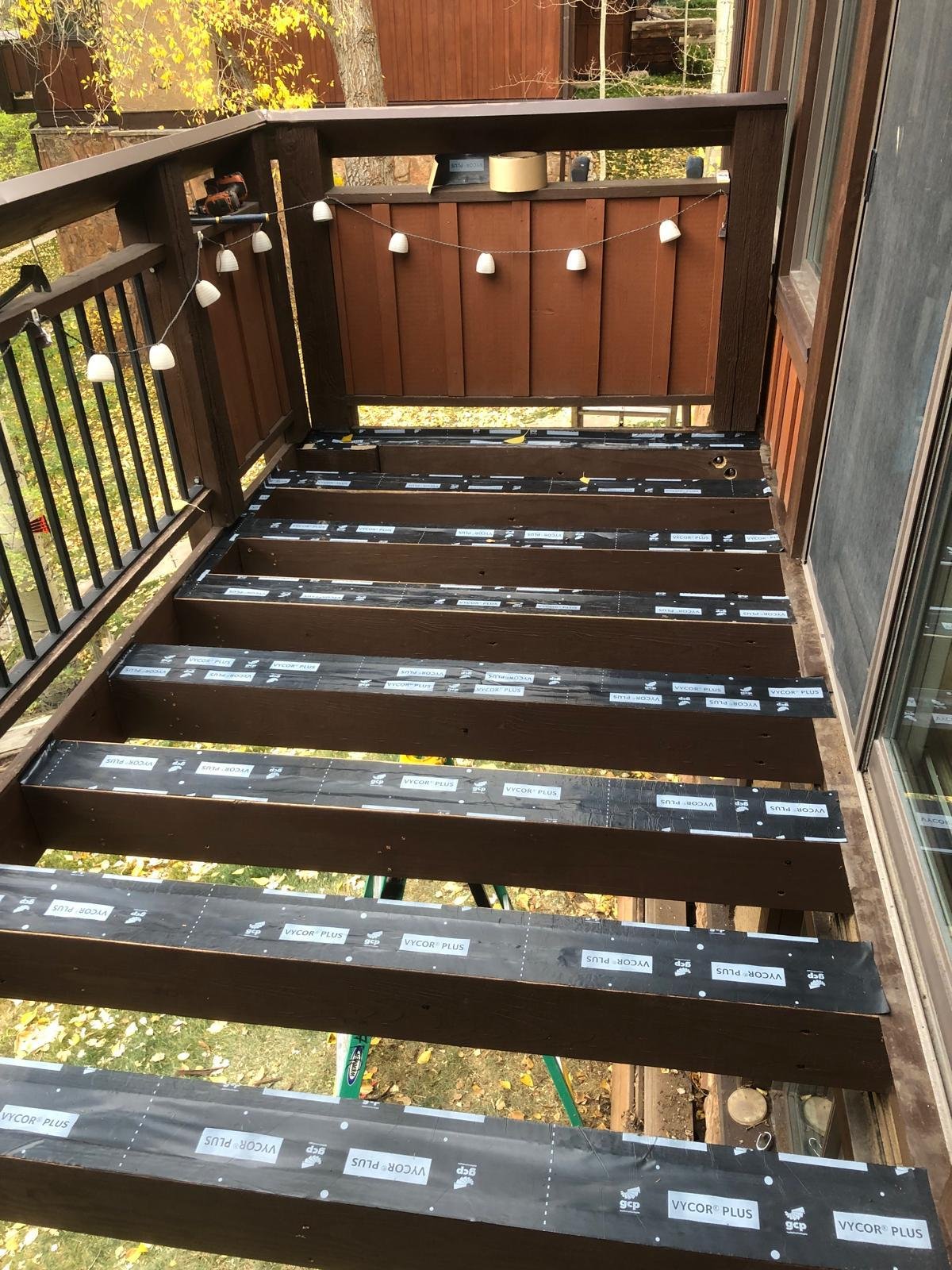
Tape on the joists. The top edge of every joist is where water pools once the decking is down. Taped, that edge stays dry and the frame outlives the surface.
Footings below frost. Frost heave is what lifts a deck on one corner and racks it out of square. Footings go deep enough for the ground here, not deep enough for a catalog.
Drainage and airflow underneath. A deck that can’t dry out rots from the bottom, where nobody looks until a board gives.
None of that shows in a photo. It’s the difference between a deck that needs work in fifteen years and one that needs work in five.
What I build
New decks, replacements, and everything attached to them
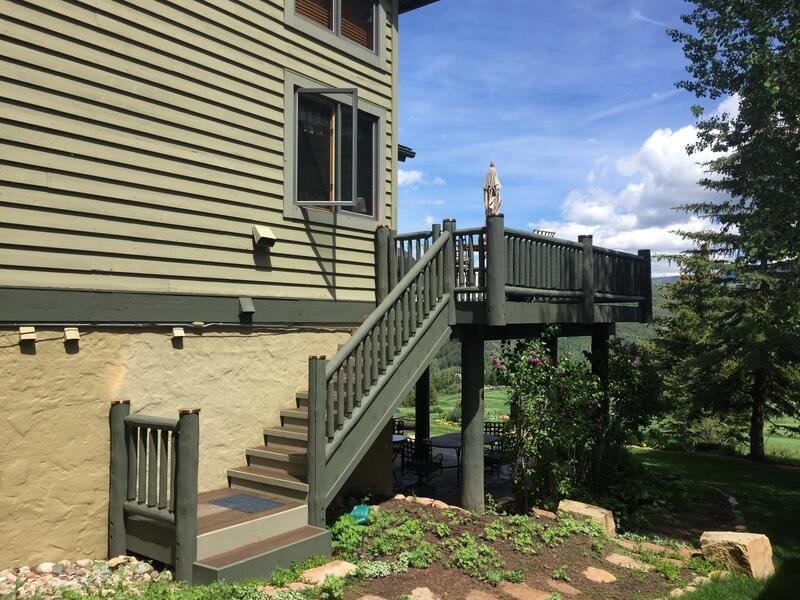
Custom deck building from footings up, plus the stairs, railing and storage that come with it.
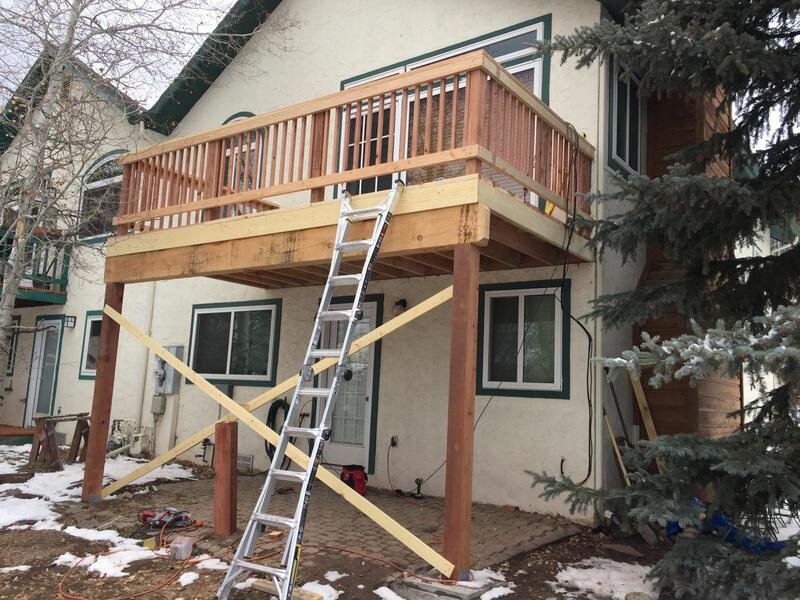
- New deck constructionGround-level, raised, or multi-level — framed, decked and railed from footings up.
- Full deck replacementWhen the old one is past repairing, the frame comes out with it and the new one is built right.
- Stairs & landingsStringers cut on site, treads that don’t flex, and stairs that still feel solid in year ten.
- RailingsWood, cable or metal balusters, built to code height and set so posts don’t work loose.
- Composite & hardwood deckingTrex and similar composites, cedar, pressure-treated, and tropical hardwood.
- Storage under and aroundSkirting, access hatches and storage builds that use the space a raised deck wastes.
A word on hardwood: it’s beautiful and it lasts, but every board has to be pre-drilled and countersunk or the screws snap off inside the wood. It doesn’t forgive being rushed, which is why not everyone will quote it.
Already have a deck that’s failing? That might be a repair, not a rebuild — see deck repair, and I’ll tell you which one you’re looking at.
From a customer
★★★★★
“Esaú completed a deck remodel for us and provided a reliable timeline for the project’s completion. The deck exceeded our expectations; he listened to our request, incorporated the details we wanted, and paid close attention to everything we envisioned. Everyone compliments its beauty, and we are thrilled we chose him for our remodel. Thank you, Esaú!!”
“A reliable timeline.” That’s the part most people are really asking about when they call — not whether the work will be good, but whether anyone will show up and finish. Cherie recorded this on her own phone after her deck was done.
How it works
Four steps, no surprises
On site, in person, no charge. We walk the space, talk through size and layout, and I look at what the ground and the house will allow.
Build new, rebuild, or repair what’s there — I’ll tell you which. I’ve talked people out of jobs I could have taken.
Built from how many days the job takes and how many hands it needs. Not a number pulled out of the air.
I’m not a sales office that subcontracts your job down a chain. When you hire me, I’m the deck builder on your deck.

Who you’re calling
Esaú Bejarano Williams
Twins Wood Works is a family business. Eleven years of carpentry in these mountains — decks, window replacement, interior and exterior trim, siding and fences — most of it in Eagle and Garfield County. I don’t install cabinets or doors, and I’ll tell you that up front rather than take the job and figure it out later.
“I tell people what works for them and what doesn’t, and nothing else. If I can’t do the job right, I’ll say so and tell you to find someone who can.”
When you call this number you get Esaú — not a call center, not a dispatcher, and not a company that sends the job down a chain of subcontractors until whoever shows up is three people removed from the price you agreed to.
Request your free estimateWhat a deck costs
Nobody can price a deck from a photo
Most deck builders will give you a number over the phone. Two decks the same size can be thousands apart, and it usually has nothing to do with the decking. Here’s what actually moves it.
A deck two feet off the ground and one twelve feet up are different jobs — footings, posts, railing, and how much of it you can reach from the ground.
Pressure-treated, cedar, composite and hardwood are four very different numbers, and they age four different ways.
Flat, firm ground is straightforward. A slope, rock, or a spot that holds water changes the foundation work before anything gets framed.
The flat part is the cheap part. Stairs, landings and railing are where the labor goes.
I build the estimate from days of work and how many hands the job needs, and I walk you through it line by line. You’ll know what you’re paying for before anything starts.
Where I work
Deck building across Eagle, Garfield, Pitkin, Summit & Routt County
Most of my deck building has been in Edwards, Avon and Eagle. I run the I-70 corridor from Rifle and Glenwood Springs up through Vail, down the Roaring Fork Valley to Carbondale, Basalt, Snowmass and Aspen, and over to Summit County and Steamboat Springs.
Edwards, Avon, Beaver Creek, Vail, Eagle, Gypsum, Minturn, Wolcott
Glenwood Springs, New Castle, Silt, Rifle, Carbondale, Parachute
Aspen, Snowmass Village, Basalt, Woody Creek
Breckenridge, Frisco, Silverthorne, Steamboat Springs
Not sure if you’re in range? Call and ask. I’d rather tell you no on the phone than waste your time.
Common questions
What people ask before they call
Do I need a permit to build a deck in Colorado?
Usually yes, and it depends on the county or town and on the size and height of the deck. Requirements are not the same in unincorporated Eagle County, in Garfield County, or inside town limits in Vail or Aspen. I’ll tell you what applies to your property before we start, so it doesn’t turn into a surprise halfway through.
How much does it cost to build a deck?
Deck contractors around here will quote anywhere from a few thousand to six figures, and both can be honest — it depends on size, height, material and what’s under the ground where it’s going. Two decks with the same square footage can be thousands apart once you factor in stairs, railing and foundation work. That’s why the estimate is free and done on site.
What’s the best decking material for this climate?
There’s no single answer, and anyone who gives you one is selling something. Composite holds up to the snow with almost no maintenance but costs more up front. Cedar and pressure-treated look and feel better underfoot and cost less, but they need sealing to last here. Hardwood outlasts all of it and costs accordingly. I’ll tell you what each one will actually do on your deck, and you decide.
How long does it take to build a deck?
It depends on size and access more than anything. What I can tell you is that I give you a timeline before we start and I keep you posted if anything moves. Not knowing when someone will show up is the most common complaint people have about this trade, and it’s the easiest one to avoid.
When is the best time of year to build a deck?
The building season up here is short, and the good crews book out ahead of it. If you want a deck for summer, the time to have the conversation is well before summer — by the time the snow is gone, the calendar is usually full.
Can you build on a slope?
Yes, and a lot of the lots around here are exactly that. It changes the foundation work and usually the height, which changes the railing and the stairs. It’s more work, not a problem — but it’s a real reason two decks the same size can price differently.
Should I repair my old deck or build a new one?
If the frame underneath is sound, replacing the decking and railing gets you years more out of it for a fraction of a rebuild. If the joists, the beams or the ledger are gone, putting new boards on top of them just hides the problem. I’ll get under it and tell you which one you have — see deck repair.
Do you do the railing and stairs too?
Yes. Framing, decking, stairs, landings and railing are all one job to me. The stairs and railing are where most of the labor goes and where most of the failures start, so they’re not something to hand off to someone else.
Get a free estimate on your deck
Call or text and I’ll come look at it. No charge, no obligation, and a straight answer about what it needs.
(970) 315-7766